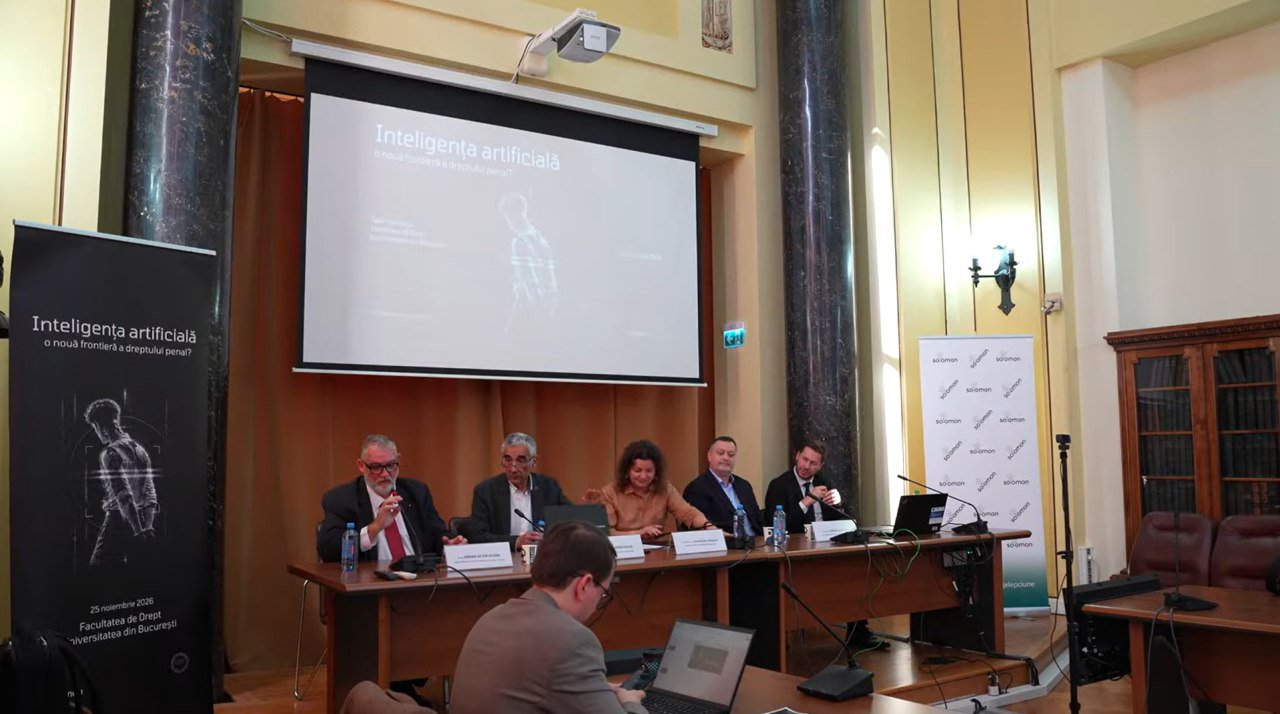
How can liability be established when an artificial intelligence system causes harm? To what extent can an action autonomously performed by such a system be reconstructed, and what relevance do the findings of technical analysis have in a criminal investigation? These were among the questions addressed at the conference “Artificial Intelligence – A New Frontier of Criminal Law?”, held on Wednesday, November 25, 2026, at the Faculty of Law of the University of Bucharest.
Dr. Eng. Adrian-Victor Vevera, Director General of the National Institute for Research and Development in Informatics – ICI Bucharest, presented the applied research perspective on the autonomy of artificial intelligence systems, their vulnerabilities, and the possibilities of reconstructing their behavior in the event of an incident.
Unlike systems that assist users in making decisions, AI agents can interact with other computer systems and execute operations without human intervention at every stage. In this context, the Director General of ICI Bucharest emphasized the importance of examining human decisions regarding system design and configuration, data access, and authorized operations.
“The more operations we delegate to an AI system, the more important it becomes to understand what level of control we retain over it. When an action produces serious consequences, including consequences that could become the subject of a criminal investigation, it matters whether the system merely proposed an operation or was authorized to execute it, and whether the person responsible for supervising it actually had the ability to intervene. The question is not only how autonomous an AI system can become, but also how much autonomy we choose to grant it, for which operations, and with what control mechanisms,” stated Dr. Eng. Adrian-Victor Vevera, Director General of ICI Bucharest.
Another topic addressed was the vulnerabilities of artificial intelligence systems. Drawing on the example of the wrongful identification of a suspect through a facial recognition system, the presentation highlighted the need to distinguish between errors caused by the data used, improper use of the technology, and deliberate manipulation of the system. From a cybersecurity perspective, testing must also examine how systems respond to false information, malicious instructions, and unforeseen situations.
In the context of an investigation, technical logs can provide information about the commands received, the data accessed, and the actions performed by an AI system. However, these records alone are not sufficient to explain how an incident occurred. They must be correlated with information about user access, system configuration, and any external interventions.
The conference also explored the extent to which fundamental concepts of criminal law, such as culpability, criminal liability, and causation, can address situations arising from the use of artificial intelligence.