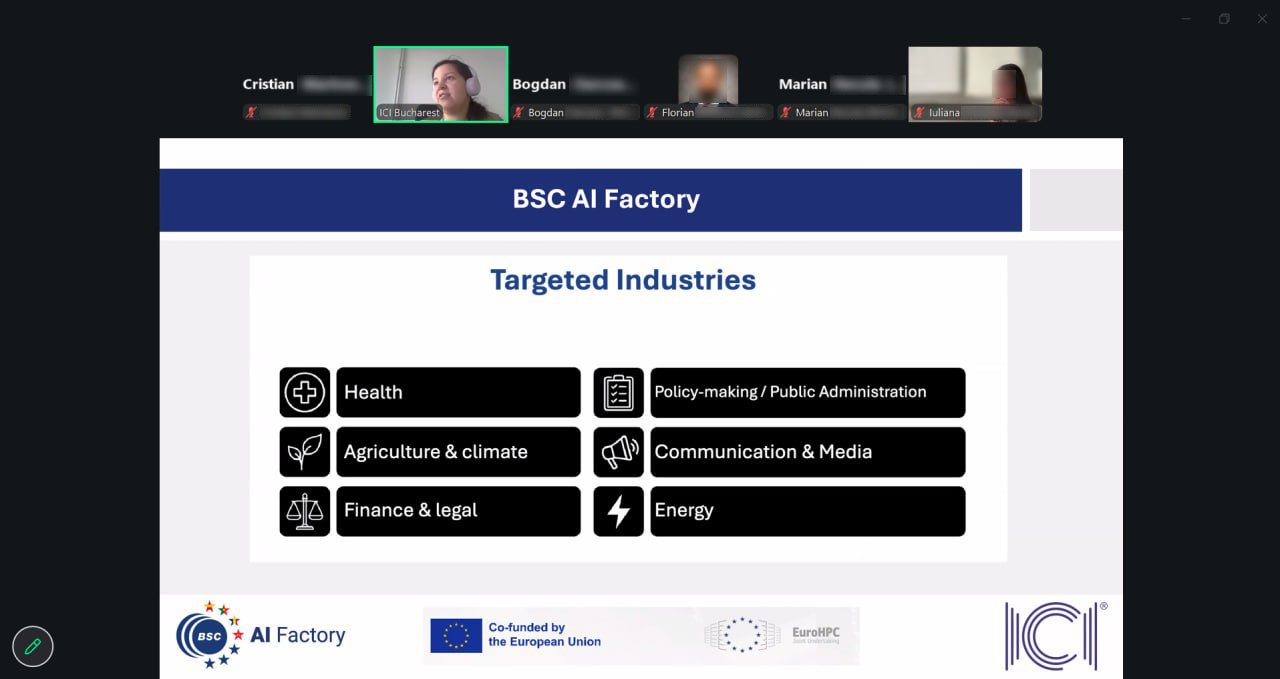
The National Institute for Research and Development in Informatics (ICI Bucharest) hosted the online workshop “Natural Language Processing (NLP): Text Classification, Entity Recognition, Summarization & Large Language Models” on Wednesday, 7 October 2026, as part of the BSC AI Factory project.
The session took a practical approach, with 87.5% of participants who completed the follow-up survey stating that they intended to apply what they had learned in their professional activities. In addition, the proportion of participants who rated their knowledge as high increased from 11.1% before the workshop to 38.9% afterwards.
The workshop covered the main stages and tools used in Natural Language Processing, from text preprocessing and classification to Named Entity Recognition, automated summarization, Transformer models, and Large Language Models (LLMs). Participants explored examples and explanations of how these techniques can be applied in real-world scenarios, including through the use of prompts and large language models.
The session also addressed the limitations and risks associated with LLMs, helping participants understand not only the potential of these technologies but also the key considerations involved in their responsible use. The format combined theoretical explanations with practical examples to facilitate understanding of how different NLP techniques can be integrated into an applied workflow.
Feedback survey results indicated a very positive assessment of the session: 88.9% of respondents gave the workshop the maximum rating of 5 out of 5, while the remaining participants rated it 4 out of 5. Furthermore, all respondents found the learning materials accessible, and the examples and session format were praised for their clarity and practical value.
Through the activities organized under the BSC AI Factory project, ICI Bucharest contributes to the development of artificial intelligence skills and the creation of practical learning opportunities, enabling participants to understand and experiment with technologies relevant to their professional, academic, and research activities.